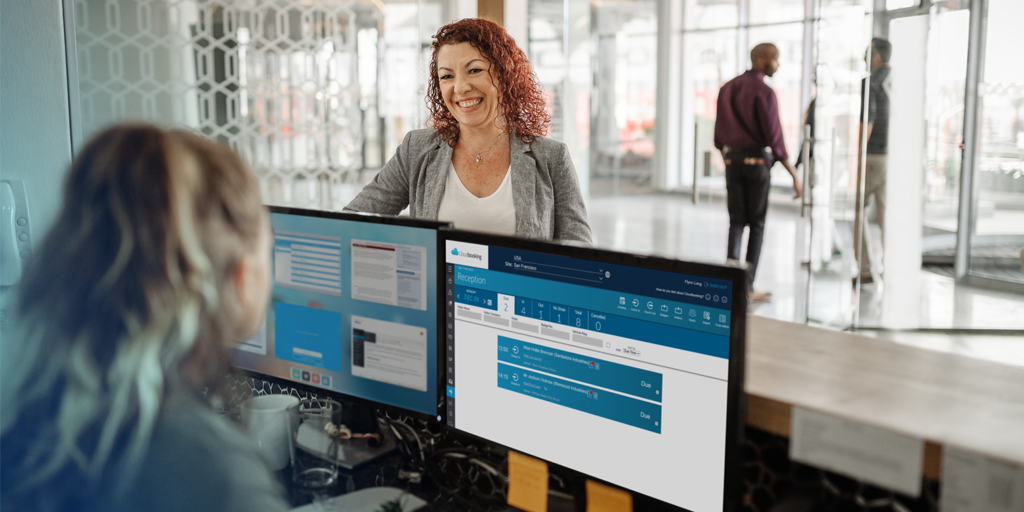
Room booking is a system that allows employees to reserve meeting rooms in advance, usually through a web portal, mobile app or directly inside tools such as Microsoft Outlook.
In simple terms, room booking ensures that meeting space is allocated clearly and consistently.
In reality however, in modern workplaces where rooms are shared and demand fluctuates, structured booking prevents scheduling clashes, improves visibility and provides measurable data on how meeting space is used, which all ensures meeting rooms are consistently operating as a value-add estate asset.
Why is Room Booking Important?
Meeting rooms are finite resources and demand is rarely evenly distributed. Hybrid and flexible working have only amplified that imbalance and in most offices, usage clusters mid-week and during core hours, which is when pressure on collaboration space becomes most visible.
When there is no structured booking system in place, predictable problems emerge. Rooms are double-booked, reserved but never used or even taken by smaller groups who simply chose the largest available space. Employees end up walking floors looking for somewhere free, whilst workplace teams have to apply guesswork over whether there is a capacity issue.
In most unsupported offices, the issue is not the number of rooms but the lack of visibility and control.
Room booking changes that by making availability clear before meetings are scheduled, reducing conflict and uncertainty. A simple fix that assists in eliminating double bookings and ghost bookings, but at the same time it gives workplace teams insight into demand patterns so they can address pressure points early rather than reacting once frustration builds.
Beyond visibility and space optimisation, structured room booking also supports productivity. When employees can secure the right space in advance, meetings start on time and distractions are reduced. There is less interruption, less searching and less time spent resolving avoidable conflicts. The same can be said for workplace teams, where it removes much of the reactive noise. Instead of handling issues around unavailable rooms or double bookings, they can focus on improving layout, planning capacity and responding to real demand patterns.
In short, room booking reduces operational friction across the board and ensures that your space is adding to your team’s success.
How Does Room Booking Work?
At a functional level, room booking operates as a reservation system. A user selects a room, chooses a date and time and confirms the booking. The space is then reserved and reflected in shared calendars.
More advanced room booking systems typically showcase live availability through interactive floorplans and calendars, whilst allowing organisations to configure rooms by capacity and available equipment, apply booking rules or time limits, restrict certain spaces to specific teams and introduce approval processes where required. Many platforms also support check-in and auto-release features.
Check-in functionality is particularly important. If a meeting organiser does not confirm attendance, the room can be released automatically. This reduces ghost bookings and provides organisations workplace data, giving them the advantage and opportunity to make data-backed workplace decisions.
Related Reading: What is Desk Booking?
What’s the Difference Between Room Booking and Calendar Booking?
Many organisations rely solely on shared calendars to manage rooms. While this enables basic reservation, it does not provide governance, reporting or insight.
Dedicated room booking software typically includes policy enforcement, capacity management, check-in controls, reporting and analytics, along with real-time visibility across multiple floors or sites, aswell as many other benefits such as resource request and hospitality ordering. These capabilities go beyond simply reserving space and add measurable value to a workplace.
A shared calendar shows whether a room appears booked. A room booking system provides insight into whether rooms are being used effectively and consistently, whilst helping to ensure they are. That distinction becomes important when meeting space is limited or under review.
What Problems Does Room Booking Solve?
Room booking addresses several operational challenges. It prevents double bookings and scheduling conflicts, whilst also reducing wasted capacity caused by cancelled or unattended meetings.
Beyond conflict prevention, structured room booking provides data on peak demand days, frequently used rooms, underutilised spaces and booking or cancellation patterns. This information supports informed decisions around room configuration, layout changes and whether additional collaboration space is genuinely required.
Without structured booking and reporting, room planning is often driven by assumption rather than evidence. With clear data, organisations can make decisions based on measurable usage and effectively improve productivity in the workplace, reduce estate costs or increase employee experience.
Is Room Booking Only Relevant in Hybrid Workplaces?
No, whilst hybrid working has a clearer need for room booking software, room booking is relevant in any organisation where meeting space is shared. It is commonly used in corporate headquarters, public sector buildings, multi-site organisations, consolidated offices with reduced footprint and any office space that effectively manages its workplace.
Any workplace where rooms are shared benefits from structured management and clear visibility over availability.
What Features Should Room Booking Software Include?
When evaluating room booking platforms, certain features are fundamental. As such, you should ideally be looking out for:
• Live availability visibility
• Interactive floor plans
• Booking rules and permissions
• Check-in and auto-curtailing
• Integration with existing systems
• Clear reporting dashboards
Without reporting, room booking exists as a functional tool only. However, when analytics and reporting is included, it becomes a strategic tool that supports space planning and workplace decision-making.
Final Thoughts
Room booking is a system for reserving and managing shared meeting space. It improves visibility, reduces scheduling conflicts and provides measurable data on room usage.
In workplaces where collaboration space is limited and demand fluctuates, room booking introduces structure and insight. Whilst thought to be simply about reserving rooms, room booking is fundamentally about managing meeting space effectively and ensuring it supports how people work.
Unsure how to get started with room booking? Take a look at our case studies or get in touch today. We know a thing or two about helping build adaptive workspaces after all.